
St Anne's Infants' School & Nursery Reach for the Stars
Phonics
At St Anne’s Infants’, we believe that learning to read is one of the most exciting adventures a child can take! We follow the Fischer Family Trust Success for All Phonics programme, a complete, systematic synthetic phonics programme validated by the Department for Education (DfE).
Phonics is at the heart of our curriculum and is taught daily through engaging phonics and shared reading lessons, helping children to recognise letters and sounds, blend sounds to read words and segment words to support their spelling.
We regularly assess children’s progress, celebrate their achievements and provide additional support where needed, ensuring every child has the opportunity to become a confident, successful reader and writer.
Each week, children take home a decodable reading book and a shared reading book linked to their classroom learning, giving them the opportunity to practise their phonics skills, build fluency and develop confidence at home. By working together with families, we aim to nurture a lifelong love of reading and writing in every child.
Useful information for parents/carers
At St Anne’s Infants’, we believe that working together helps every child become a successful and adventurous reader. The resources below will help you understand how we teach phonics and how you can support your child’s reading journey at home.
Terminology
Discover the key phonics words and phrases your child may use at school, with explanations to help you support their learning at home:
Parent and Carer Guide
Find out how the Success for All Phonics programme works and learn more about how children develop their reading and spelling skills:
- Success for All Parent/Carer Guide
- Our Approach to Teaching Phonics
- Learn how we teach phonics at St Anne’s Infants’ and how our Success for All Phonics approach helps children become confident readers and writers. You can also explore our Reception and Year 1 Scope and Sequence to discover which GPCs (grapheme–phoneme correspondences) and red words your child will be learning each week, so you can support their phonics journey at home:
- SFA Phonics at St. Anne's
- Success for All Reception and Year 1 Scope and Sequence
- Starting the Reading Journey
- Find out what your child will learn in Reception and how you can help them practise their sounds and early reading skills at home:
- SFA Phonics in Reception
- Building Reading Confidence
- Discover how phonics learning develops in Year 1 as children strengthen their knowledge of sounds, improve their fluency and grow in confidence:
- SFA Phonics in Year 1
- Moving onto Year 2
- Building on their phonics learning in Reception and Year 1, children continue to develop their reading skills through Routes to Reading and learn spelling patterns through Jungle Club. These programmes help children strengthen their reading fluency and comprehension, expand their spelling knowledge and become increasingly confident, independent readers and writers.
- You can explore our Jungle Club Scope and Sequence below to see the spelling patterns your child will be learning in Year 2 and how you can support their spelling development at home.
- Year 2 Jungle Club Scope and Sequence
-
-
GPC Pronunciation Videos
Listen to videos demonstrating how to pronounce the sounds (grapheme–phoneme correspondences, or GPCs) taught in our phonics programme. These can be a helpful guide when practising phonics with your child at home. Please click here for SFA GPC pronunciation videos.
You may also find the Parent Portal useful to support your child’s phonics and early reading as there are a wealth of materials, helpful videos and tips for reading at home on this platform.
https://parents.fft.org.uk/tips-for-home-reading/#1647512448481-bc17c3b7-263e
GPC mats
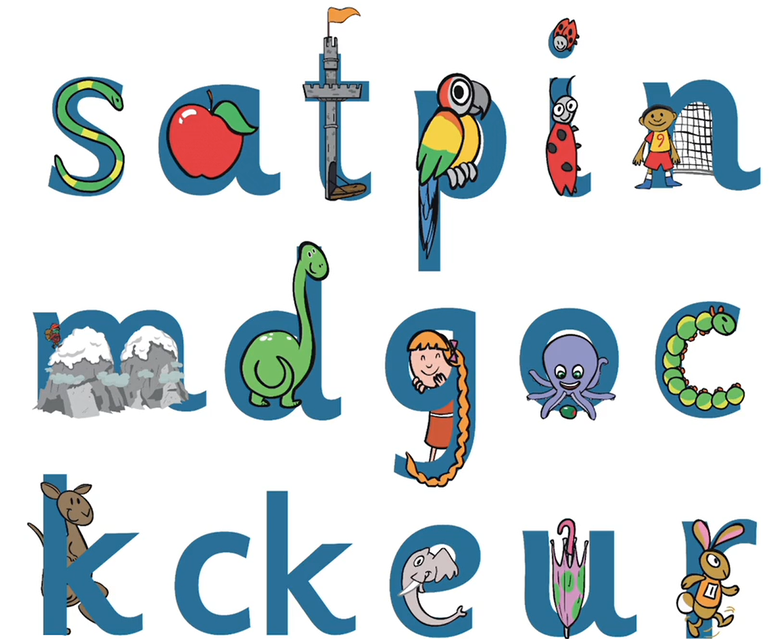
Please find below the Reception and Year 1 GPC mats which are used to support the children with writing words containing the GPCs. The children use the pictures to support them in finding the right GPC e.g. when looking for the /oa/ GPC, the children are able to find the 'goat in a boat' picture and make the association between the picture and the GPC.
Letter formation
For each letter of the alphabet the children will learn a short alliterative phrase to help them to learn how to form it correctly in their writing, e.g. for ‘c' it is 'curl around the caterpillar.’ These alliterative phrases are a great prompt to use with your child at home to support them in forming each letter of the alphabet correctly. Please ask your child's class teacher if you would like a hard copy of this resource (Reception families, these have been provided already for you to use at home).
Red Words
As the children progress through the phonics and shared reading programme, they will learn new 'red words' as well as consolidate previously taught red words. Red words are also known as 'common exception words' or 'sight words' as they require the children to be able to automatically read them rather than segment and blend them. Knowing how to read these words quickly increases the fluency and pace of reading and therefore practising these regularly will really support your child's reading.
Below is the list of red words that children need to be able to read and write by the end of Year 1. The words in blue are words that all children will be able to read and write by the end of Year 1 and the orange are supplementary words that will still need to be learnt.
Year One Phonics Screening Assessment
It is a statutory requirement for children in Year One to complete a phonics screening check. The purpose of the screener is to confirm that all children have learnt phonic decoding to an age-appropriate standard.
The screener contains real and pseudo words (sometimes known as nonsense words or alien words).
The assessment is carried out by your child's class teacher in a set week in June. The children complete practice screenings throughout the year and read pseudo words as part of their phonics lessons, making the format of the screener very familiar to them.
More information and copies of previous years' checks can be found below :
https://www.gov.uk/government/publications/phonics-screening-check-2025-materials
https://collins.co.uk/pages/what-is-the-phonics-screening-check
If a child does not pass the screening check in Year 1, they re-take it at the end of Year 2.
Homework
At the end of each week, your child will be provided with Phonics homework which will allow them to practise their learning at home. This will cover a range of green (decodable) words, where they will use the sounds they have been taught, and new red words (non-decodable) that they need to read by sight.